WhatsApp Business API Pricing in India (2026): Message Rates, Costs & Calculator
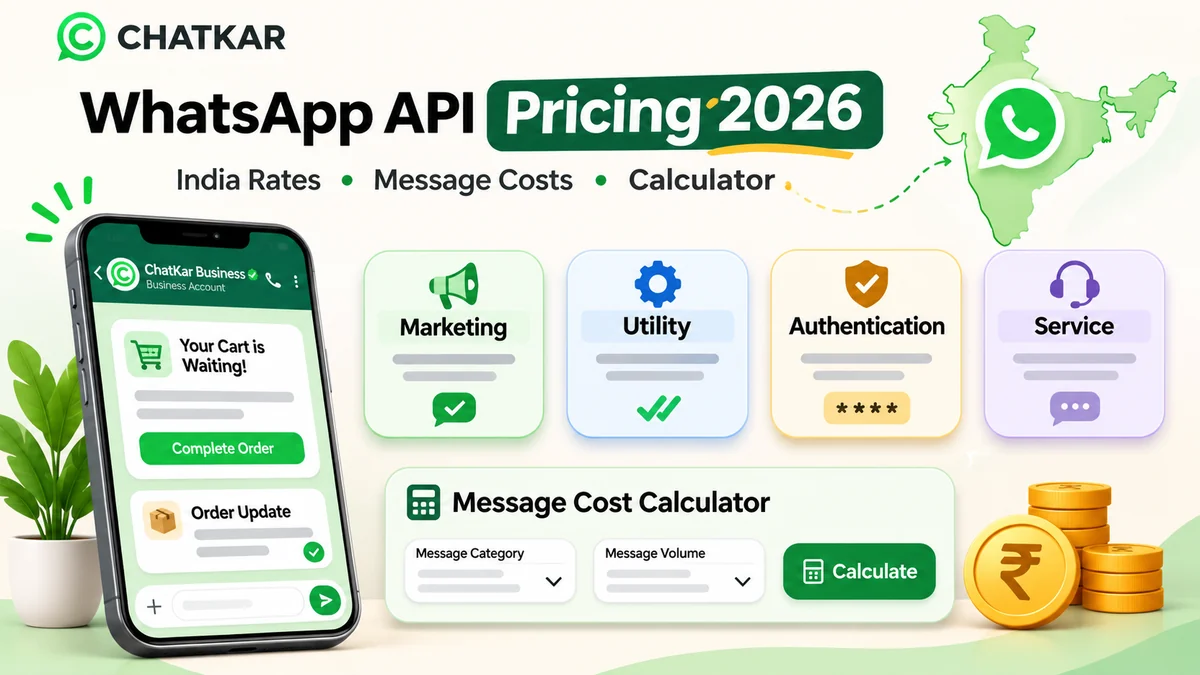
WhatsApp Business Platform allows companies to communicate with customers through notifications, promotional campaigns, authentication messages and customer support conversations. But before implementing WhatsApp automation, businesses need to understand how message pricing works.
WhatsApp Business API pricing in India depends on the message category, the recipient's country, the number of messages delivered and any additional charges from the service provider.
Meta moved to per-message pricing in July 2025. The India rates below reflect the rate card effective October 1, 2026. This guide explains the four main categories, how the charges are calculated, what may be free and how to estimate a monthly messaging budget.
Quick answer: What is WhatsApp API pricing in India?
Under the India rate card effective October 1, 2026, the listed Meta charges per delivered message are:
- Marketing: ₹0.8631
- Utility: ₹0.1150
- Authentication: ₹0.1150
- Service: first 1,000 eligible service messages per business phone number each month free, then ₹0.1150 per message.
These are Meta message charges, not a complete WhatsApp CRM or provider subscription price. Taxes and provider charges may be additional.
1. WhatsApp Business API Message Rates in India – 2026
Meta uses message categories to determine the applicable rate. The category depends on the purpose and content of the message, not simply the business's preferred label.
📣
₹0.8631
Marketing
📦
₹0.1150
Utility
🔐
₹0.1150
Authentication
💬
₹0.1150*
Service
*Service messages: first 1,000 free per business phone number per month; the listed rate applies after that allowance. Rates shown are before any applicable taxes or provider fees.
| Message category |
Meta rate in India |
Typical purpose |
| Marketing |
₹0.8631 |
Offers, promotions, product launches, re-engagement and promotional reminders. |
| Utility |
₹0.1150 |
Order confirmations, delivery updates, account notifications and transactional information. |
| Authentication |
₹0.1150 |
Login codes, OTPs and account verification. |
| Service |
₹0.1150 after the free allowance |
Customer service replies in the 24-hour customer service window. |
These rates apply to messages delivered to Indian recipients under the India rate card. Pricing can differ for recipients in other countries. Check the latest Meta rate card before preparing a final customer quotation.
2. Understand the Four WhatsApp Message Categories
Marketing Messages
Marketing messages are used to promote products, services, offers and business announcements. They can help businesses reach customers who have opted in to receive marketing communication.
Examples include:
- Festival and seasonal offers.
- New product announcements.
- Discount and promotional campaigns.
- Special launch announcements.
- Promotional abandoned-cart reminders.
- Customer re-engagement campaigns.
India Meta rate: ₹0.8631 per delivered marketing message.
Utility Messages
Utility messages provide information about a specific transaction, account, service or action requested by the customer. Their content should remain relevant to that purpose and should not become a promotional message.
Examples include:
- Order confirmation.
- Payment confirmation.
- Delivery and shipping updates.
- Appointment confirmation.
- Booking status.
- Account-related notifications.
India Meta rate: ₹0.1150 per delivered utility message.
Authentication Messages
Authentication messages are used to verify a customer's identity or help the customer access an account securely.
Examples include:
- Login OTP.
- Registration verification code.
- Password reset code.
- Account verification code.
India domestic authentication rate: ₹0.1150 per delivered message.
Service Messages
Service messages are free-form customer support replies sent within the 24-hour customer service window after the customer messages the business.
Examples include:
- Answering a customer's product question.
- Helping with an order issue.
- Responding to a service request.
- Providing support for an existing booking.
India service pricing: First 1,000 service messages per business phone number per month are free. Additional service messages are ₹0.1150 each.
3. How WhatsApp Message Billing Works
WhatsApp Business Platform pricing is based on the category and delivery of the applicable message. Businesses should distinguish between the WhatsApp message charge and the fee charged by the platform or provider they use.
How a WhatsApp Message Gets Billed
An animated, coding-only explanation of the billing journey.
✉️
1. Message created
Business prepares a message using an approved template or an eligible service reply.
🏷️
2. Category checked
The message is assessed as marketing, utility, authentication or service.
📲
3. Message delivered
The relevant delivery event determines whether a Meta message charge applies.
🧾
4. Cost calculated
The applicable rate and any additional provider or tax charges are considered.
4. What Changed in WhatsApp Pricing in October 2026?
Businesses should pay attention to the October 1, 2026 pricing changes when estimating the cost of customer service and transactional messages.
- The first 1,000 eligible service messages per business phone number per month remain free.
- After the free service-message allowance, service messages are billed at the applicable India rate of ₹0.1150 each.
- Utility templates are chargeable at the applicable utility rate, including when sent during an open 24-hour customer service window.
The 24-hour customer service window is still important because it determines when a business can respond using free-form messages instead of an approved template. However, it should not be confused with a guarantee that every message sent during the window is free.
5. Which WhatsApp Messages Are Free?
Not every interaction creates a Meta message charge. The following distinctions are useful when planning costs:
| Message or event |
Meta charge |
Important detail |
| Customer sends a message to the business |
No charge for the incoming message |
It may open or reset the 24-hour customer service window. |
| First 1,000 service replies per month |
Free |
Allowance is per business phone number. |
| Service replies after the allowance |
₹0.1150 per message |
India rate shown before other fees or taxes. |
| Marketing template delivered |
₹0.8631 per message |
Marketing rate applies to eligible delivered messages. |
| Utility template delivered |
₹0.1150 per message |
Utility templates are chargeable under the October 2026 rules. |
| Authentication template delivered |
₹0.1150 per message |
Domestic India rate. |
Free-entry-point rules may also apply to certain conversations initiated through eligible Click-to-WhatsApp ads. Their eligibility and duration have specific conditions, so businesses should consult Meta's current documentation before including those messages in a cost forecast.
6. Interactive WhatsApp API Cost Scenarios
Select a sample monthly usage level below to see an illustrative Meta message-cost calculation. These are predefined examples, not a live billing estimate.
7. How to Calculate Your WhatsApp API Cost
The basic calculation is straightforward. Multiply the delivered message volume in each category by its applicable Meta rate, then add any billable service messages.
Basic monthly cost formula
Marketing cost = Marketing messages × ₹0.8631
Utility cost = Utility messages × ₹0.1150
Authentication cost = Authentication messages × ₹0.1150
Service cost = Maximum of (Service messages − 1,000, 0) × ₹0.1150
Total Meta message cost = Marketing + Utility + Authentication + Service costs.
For example, suppose a business sends 3,000 marketing messages, 5,000 utility messages, 1,000 authentication messages and 2,000 service messages in a month.
| Category | Calculation | Cost |
|---|
| Marketing | 3,000 × ₹0.8631 | ₹2,589.30 |
| Utility | 5,000 × ₹0.1150 | ₹575.00 |
| Authentication | 1,000 × ₹0.1150 | ₹115.00 |
| Service | (2,000 − 1,000) × ₹0.1150 | ₹115.00 |
| Estimated Meta message cost | ₹3,394.30 |
|---|
This is a basic estimate. The final invoice may also include applicable taxes, provider platform charges and other contracted fees.
8. Meta Charges vs WhatsApp Provider Charges
One of the most common pricing misunderstandings is assuming that Meta's message rate is the full cost of using WhatsApp Business API.
Meta charges for the applicable messaging usage. A Business Solution Provider or software platform may separately charge for its product and services.
| Charge type | What it covers |
|---|
| Meta message charges | Applicable WhatsApp messages billed under Meta's rate card. |
| Platform subscription | Software access, CRM features, inbox, automation tools and account management features. |
| Provider usage charges | Any additional per-message, markup or usage fees stated by the provider. |
| Setup charges | One-time onboarding, configuration, integration or migration services, where applicable. |
| Taxes | Taxes applied to the relevant billed services according to the supplier's invoice and applicable rules. |
Always ask your provider for a clear cost breakdown. Confirm whether Meta usage is billed directly, passed through at cost or included in a bundled plan.
9. Why Do WhatsApp API Providers Have Different Prices?
Meta publishes message rates, but providers can package their software and support in different ways.
One provider may charge a monthly subscription. Another may offer usage-based pricing. Some may include a team inbox, automation, contact management, campaign tools or onboarding in their plans.
Before comparing providers, check:
- Monthly platform or subscription fee.
- Whether Meta message charges are included or billed separately.
- Any provider markup or additional usage fee.
- Number of users and team inbox access.
- Campaign and automation features.
- CRM integrations and API access.
- Onboarding, support and configuration costs.
- GST and other applicable taxes.
10. How to Reduce Your WhatsApp Messaging Costs
Businesses should focus on useful, relevant communication rather than simply trying to send more messages.
Use the Correct Message Category
Understand the purpose of each message and use the appropriate category. Do not label a promotional message as utility to reduce costs. Meta determines whether the content meets the category requirements.
Improve Audience Segmentation
Send campaigns to customers who are relevant to the offer. Avoid repeatedly messaging inactive or uninterested contacts.
Prevent Duplicate Messages
Use appropriate automation rules to avoid sending repeated order updates, duplicate reminders or multiple campaigns for the same event.
Use Transactional Notifications Carefully
Send order and delivery updates when they are useful to the customer. Keep transactional communication focused on the transaction and separate promotional content.
Monitor Service Usage
Track service replies against the monthly free allowance for each business phone number. Monitor usage once the allowance has been consumed.
Review Campaign Results
Evaluate delivery, customer responses, conversions and opt-outs. Use the results to improve message quality and campaign targeting.
11. Interactive Knowledge Check: Identify the Message Category
Test your understanding of WhatsApp message pricing. Open each example to reveal the most likely category. Final classification depends on the complete message content and Meta's rules.
Example 1: A business sends a 20% discount offer to customers. Which category?
Answer: Marketing. The message promotes an offer and encourages a purchase.
Example 2: A customer receives an order confirmation after purchasing. Which category?
Answer: Utility. The message provides information about a specific transaction.
Example 3: A website sends a login verification code. Which category?
Answer: Authentication. The message helps verify the customer's identity or account access.
Example 4: A customer asks about a delivery, and the support team replies within the service window. Which category?
Answer: Service. This is a customer support reply within the applicable customer service window. Service-message charges and the free monthly allowance still need to be considered.
12. WhatsApp Business API Pricing for Different Business Types
E-commerce Businesses
E-commerce companies may use WhatsApp for order confirmations, shipping updates, cart recovery and product announcements. The category depends on the purpose of each message.
Educational Institutions
Educational organisations may use WhatsApp for admission enquiries, application updates, fee notifications, reminders and student support. Transactional updates and promotional course campaigns should be planned separately.
Healthcare and Clinics
Clinics may use WhatsApp for appointment confirmations and relevant reminders. Businesses must carefully assess privacy requirements and avoid sharing sensitive information through inappropriate messaging workflows.
Travel and Hospitality
Travel agencies and hotels may send booking confirmations, itinerary updates, promotional packages and customer support responses through suitable message categories.
Real Estate
Real estate businesses may use WhatsApp for project announcements, site visit confirmations, enquiry follow-ups and customer support. Promotional messages should be classified and sent according to the applicable requirements.
13. What to Check Before Buying WhatsApp API Services
Do not compare providers only by a low monthly price. Look at the complete cost and the features included in the platform.
- Is the WhatsApp Business Platform connection official?
- Are Meta message fees shown separately?
- Is there a provider markup?
- Are campaign and automation features included?
- Is a shared team inbox available?
- Can enquiries be assigned to team members?
- Are CRM and website integrations supported?
- Can the business monitor message usage and costs?
- Are setup and support charges disclosed?
14. WhatsApp Business API with ChatKar
ChatKar provides WhatsApp communication and automation capabilities for businesses. The platform's features include tools such as campaigns, team inbox, chat automation, forms and integrations.
For a business evaluating WhatsApp API costs, it is important to separate Meta message charges from the ChatKar platform subscription or other applicable service fees.
Before choosing a plan, identify the required features, expected message volume, number of users and automation requirements. Then estimate the Meta usage cost separately to understand the overall monthly budget.
Frequently Asked Questions About WhatsApp API Pricing
1. What is the WhatsApp Business API price in India in 2026?
Under the India rate card effective October 1, 2026, the listed Meta rates per delivered message are ₹0.8631 for marketing, ₹0.1150 for utility and ₹0.1150 for domestic authentication. Service messages have a free allowance of 1,000 per business phone number each month, then cost ₹0.1150 each.
2. Is WhatsApp Business API free?
The WhatsApp Business Platform is not entirely free. Customer messages received by a business are not charged as outgoing messages. A monthly service-message allowance also applies. Other delivered message categories can have Meta charges, and providers may charge separate platform fees.
3. How much does a WhatsApp marketing message cost in India?
The listed Meta India rate is ₹0.8631 per delivered marketing message under the rate card effective October 1, 2026. Provider fees and applicable taxes may be additional.
4. How much does a WhatsApp utility message cost in India?
The listed Meta India rate is ₹0.1150 per delivered utility message under the rate card effective October 1, 2026.
5. Are WhatsApp utility messages free inside the 24-hour window?
Under the pricing changes effective October 1, 2026, utility template messages are chargeable at the applicable utility rate even when sent during an open 24-hour customer service window.
6. How many WhatsApp service messages are free each month?
The first 1,000 eligible service messages per business phone number each month are free under the October 2026 pricing rules. Additional service messages are charged at the applicable rate.
7. Are WhatsApp OTP messages chargeable?
Yes. Domestic authentication messages delivered to Indian numbers have a listed Meta rate of ₹0.1150 per message under the current India rate card. International authentication pricing can be different for eligible cases.
8. Does Meta charge for every WhatsApp message sent?
Meta's per-message pricing applies to eligible delivered business messages according to their categories and pricing rules. Incoming customer messages are not charged as outgoing business messages. Service-message allowances and free-entry-point rules may also affect billing.
9. Does WhatsApp API pricing include GST?
The rates in this article are presented as Meta message rates, not a final tax-inclusive invoice. Check the tax treatment and GST shown by your billing provider or supplier before calculating the final payable amount.
10. Do WhatsApp API providers charge extra?
Some providers charge a monthly platform subscription, provider usage fee, setup charge or other service fee. These charges are separate from Meta's message rates unless the provider explicitly includes them in a package.
11. Does WhatsApp API pricing depend on the country?
Yes. Meta's rates can depend on the country of the recipient. A business sending messages to customers in different countries should check the rate card for each destination market.
12. Can I calculate my monthly WhatsApp API cost?
Yes. Multiply your estimated delivered message volume in each category by the applicable rate. Account for the free service-message allowance, any applicable volume tiers, provider fees and taxes to estimate your total monthly spend.
Conclusion
Understanding WhatsApp Business API pricing is important before launching campaigns, automations and customer support workflows. Meta's per-message rates vary by category, while the overall cost also depends on provider subscriptions, usage fees and applicable taxes.
Businesses should classify messages correctly, monitor monthly usage and estimate the cost of each workflow before scaling. A clear cost breakdown makes it easier to plan a WhatsApp communication strategy without unexpected billing.
For the most accurate budget, always verify the latest Meta rate card and compare it with your provider's complete pricing structure.
Official Resources and Further Reading
Pricing update note: This article uses the India Meta rate card effective October 1, 2026. Meta may revise rates and billing rules. Confirm the current rate card and your provider's fees before making purchasing or budgeting decisions.