WhatsApp CRM vs Traditional CRM: What’s the Difference? | ChatKar
WhatsApp CRM vs traditional CRM explained with a practical comparison of conversations, leads, sales pipelines, automation, integrations, reporting and when businesses should us
WhatsApp CRM vs Traditional CRM: What’s the Difference?
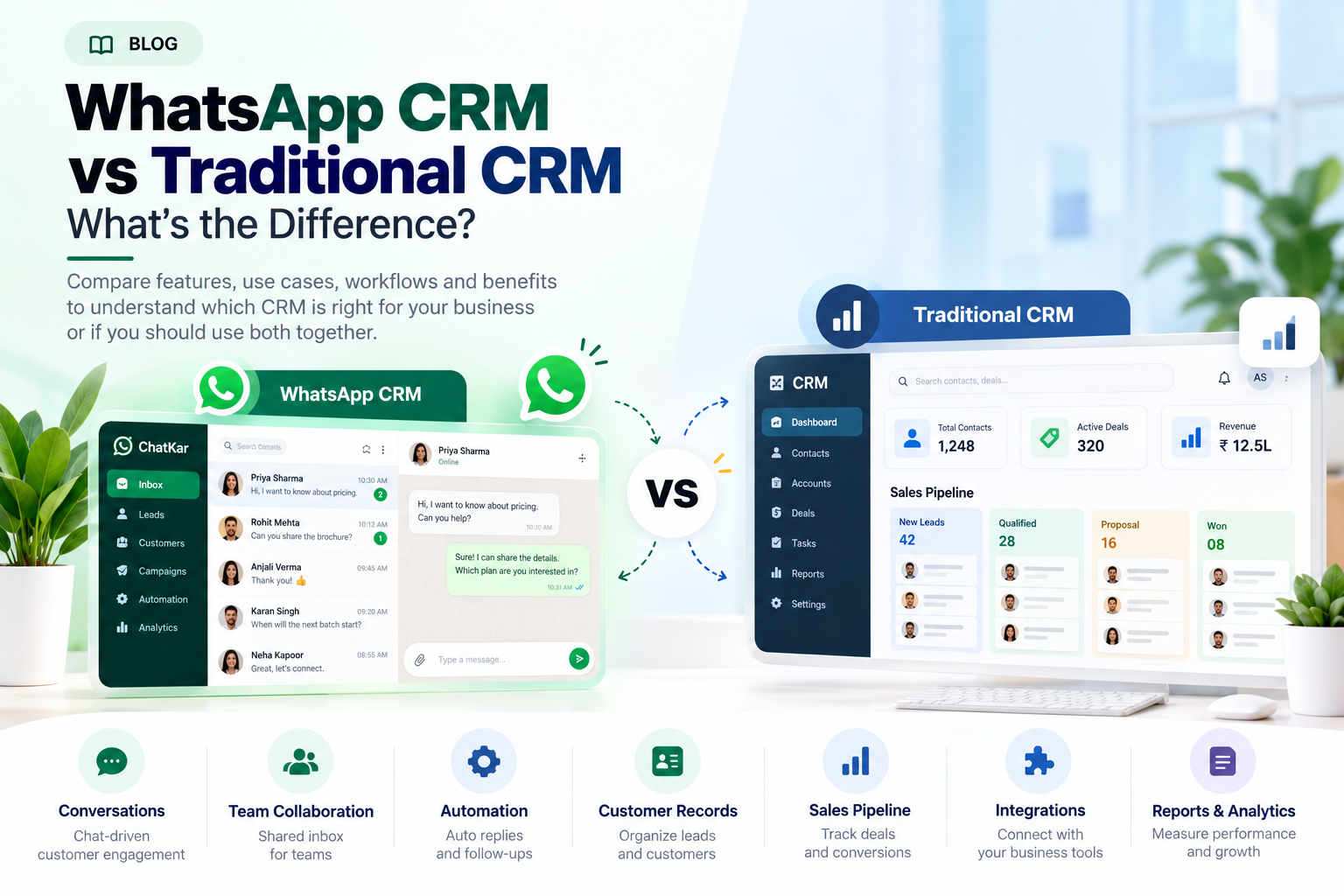
A WhatsApp CRM and a traditional CRM can both help businesses manage customers, but they usually start from different parts of the customer journey.
A traditional CRM is typically built around customer records, deals, sales pipelines and broader business processes. A WhatsApp CRM starts with customer conversations and connects those conversations with leads, teams, follow-ups and automation.
This guide compares both approaches and explains when a business may use a WhatsApp CRM, a traditional CRM, or both together.
Quick Answer: WhatsApp CRM vs Traditional CRM
The simplest distinction is: a traditional CRM organizes customer and business processes, while a WhatsApp CRM connects those processes closely to WhatsApp conversations.
The exact feature set varies between products, so compare the actual workflows rather than relying only on the product name.
Traditional CRM
Usually centered around customer records, opportunities, sales pipelines, account management, tasks and broader business processes.
Primary question: What is happening with this customer or deal?
WhatsApp CRM
Usually centered around WhatsApp conversations plus customer context, lead management, team handling and communication workflows.
Primary question: What is happening in this customer conversation and what should happen next?
The Core Difference: Record-Centric vs Conversation-Centric
One useful way to understand the difference is to look at where the workflow begins.
Customer / Deal Record
Contact → Account → Lead → Deal → Stage → Task → Follow-Up
Customer Conversation
WhatsApp Message → Customer Context → Assignment → Automation → Follow-Up
In practice, modern platforms increasingly blur this line. A WhatsApp CRM can include lead records and sales workflows, while traditional CRM systems can connect to WhatsApp. The real difference is which workflow is at the center.
WhatsApp CRM vs Traditional CRM: Complete Comparison
When Does a WhatsApp CRM Make More Sense?
A WhatsApp-centered CRM becomes more relevant when most customer interaction already happens through WhatsApp.
Most enquiries and customer conversations arrive there.
Sales and support teams need to respond inside the messaging workflow.
You need routing, follow-ups, FAQs or automated journeys.
Agents spend most of their day handling conversations rather than updating CRM screens.
When Does a Traditional CRM Make More Sense?
A broader CRM can be useful when the business needs to manage more than conversations.
The exact boundary depends on the CRM product. Some modern CRM platforms already include messaging, while some WhatsApp platforms offer substantial lead and customer-management functionality.
Can You Use WhatsApp CRM and Traditional CRM Together?
Yes. For some businesses, using both systems is more practical than trying to force every function into one product.
Customer conversation
Inbox + automation + context
Deals + accounts + reporting
In this model, WhatsApp can remain the customer-facing conversation layer while the traditional CRM manages broader business records and processes.
Example: A Hybrid WhatsApp CRM + Traditional CRM Workflow
Customer asks for pricing or product information.
Questions identify product, requirement and lead context.
Conversation reaches the correct sales person.
The opportunity can be tracked through the broader sales process.
WhatsApp remains the communication channel.
Feature-by-Feature Difference
Where ChatKar Fits
ChatKar currently positions itself as a WhatsApp-focused customer engagement platform with team inboxes, customer and lead management, broadcasts, flow automation, analytics, integrations and AI capabilities. Its current India pricing page also lists a Business Plus CRM plan. :contentReference[oaicite:1]{index=1}
Shared customer conversations
Capture and organize enquiries
Flows and follow-up workflows
Connect other business systems
Track customer activity
This makes ChatKar relevant when a business wants WhatsApp to be a major part of its customer communication and lead-management workflow, while broader CRM requirements can still be handled through integrations where needed.
Which One Should Your Business Choose?
Instead of asking which product is universally better, compare the system against the work your business actually needs to perform.
Consider a WhatsApp CRM when:
- WhatsApp is a major source of leads.
- Sales and support happen mainly in conversations.
- You need a shared WhatsApp inbox.
- Automation is important.
- Fast routing and follow-up matter.
Consider a traditional CRM when:
- You need broad account and deal management.
- Your workflow covers multiple channels and teams.
- Forecasting and pipeline management are central.
- Business reporting goes beyond messaging.
- You need a system of record for wider operations.
When Using Both Is the Better Architecture
A larger business may not need to choose only one.
Handles conversations, inbox, messaging automation and immediate customer interaction.
Handles account records, pipeline, deals, forecasting and wider business processes.
Keeps customer and lead information synchronized between the systems.
10 Questions to Ask Before Choosing
Frequently Asked Questions
Is WhatsApp CRM the same as a traditional CRM?
No. They can overlap, but a WhatsApp CRM typically puts WhatsApp conversations and communication workflows much closer to the center. A traditional CRM is usually built around broader customer, sales and business records.
Can WhatsApp CRM replace a traditional CRM?
Sometimes, depending on the business requirements and the platform's features. For complex account, deal, forecasting or broader operational needs, a traditional CRM may still be useful.
Can a traditional CRM integrate with WhatsApp?
Yes. CRM systems can connect WhatsApp through supported integrations, APIs or third-party platforms.
Which is better for sales teams?
It depends on the workflow. Teams that sell mainly through WhatsApp may value a WhatsApp-centered workflow, while teams with complex pipelines and broader account-management requirements may need a traditional CRM or a hybrid setup.
Can both systems share customer data?
Yes, where compatible integrations or APIs are available. The exact fields and synchronization depend on the products being connected.
Is WhatsApp CRM only for WhatsApp?
Not necessarily. Some WhatsApp-focused platforms also support other channels. ChatKar currently lists WhatsApp, Instagram, Facebook, Telegram, TikTok and SMS within its omnichannel feature set. :contentReference[oaicite:2]{index=2}
Does ChatKar provide CRM functionality?
ChatKar currently lists contact and lead management, team inboxes, campaigns, automation, analytics and integrations, and its India pricing page includes a Business Plus CRM plan. :contentReference[oaicite:3]{index=3}
Can WhatsApp CRM handle automated customer communication?
Compatible WhatsApp Business Platform solutions can automate supported customer journeys. Business-initiated messaging remains subject to WhatsApp's current template and policy requirements. :contentReference[oaicite:4]{index=4}
Related WhatsApp CRM Guides
Final Thoughts
WhatsApp CRM and traditional CRM are not necessarily competing ideas. They can solve different parts of the same customer journey.
A business that receives most of its enquiries through WhatsApp may need a communication-first system. A business with complex deals, accounts, forecasting and broader operations may need a traditional CRM. A larger organization may connect both.
The right question is not "Which CRM is better?"
The better question is: "Where does our customer journey actually happen, and which system should manage each part of it?"
Build a WhatsApp-Centered Customer Workflow
Explore ChatKar for WhatsApp conversations, team inboxes, lead management, automation, integrations and customer engagement workflows.
Explore Features View Pricing