WhatsApp Template Rejected? 15 Common Reasons and How to Fix Them | ChatKar
WhatsApp template rejected? Learn 15 common reasons for rejection, category mistakes, variable issues, promotional wording, quality problems and practical ways to fix templates before resubmitting.
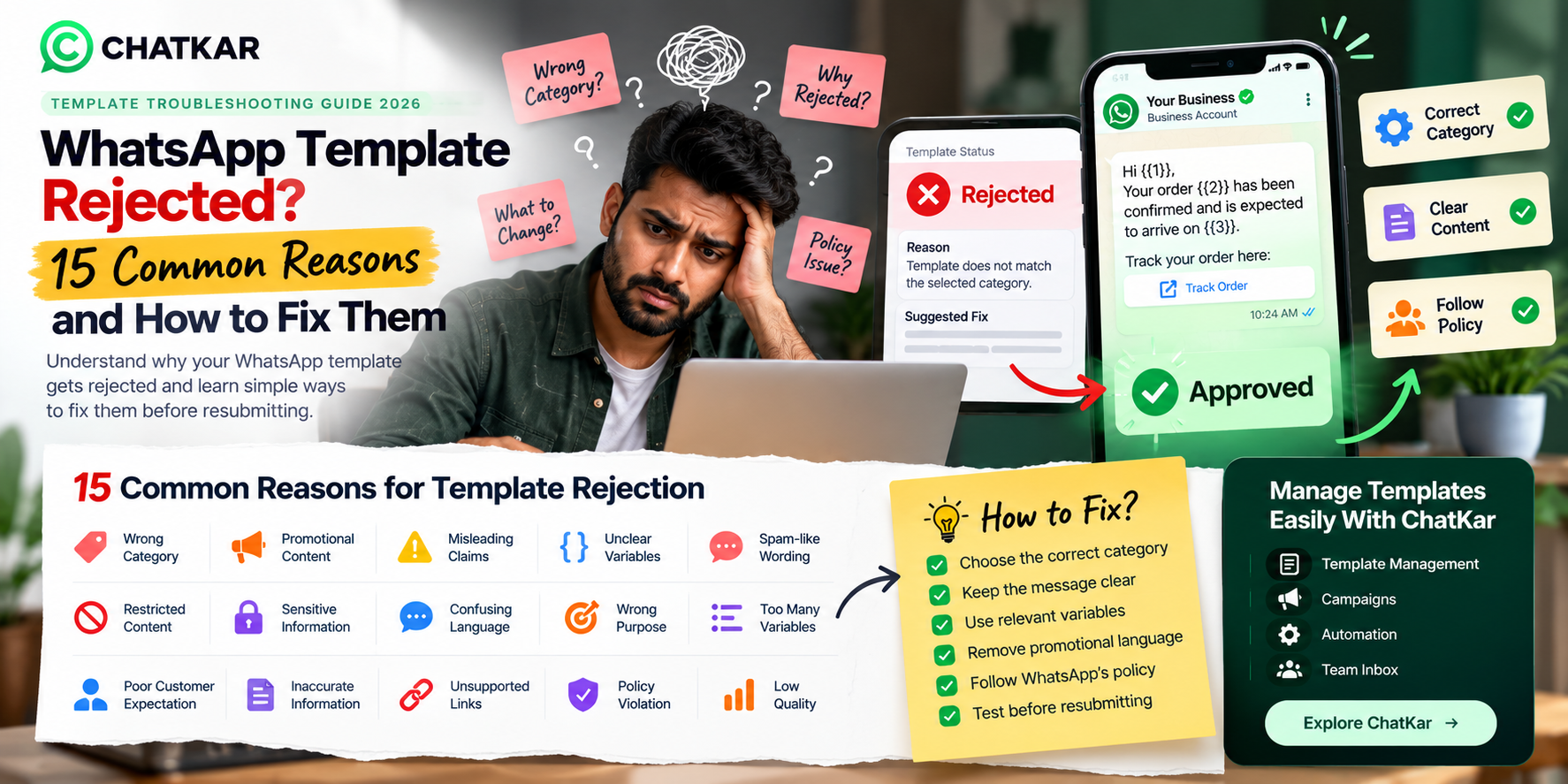
WhatsApp Template Rejected? 15 Common Reasons and How to Fix Them
A rejected WhatsApp message template can delay campaigns, customer notifications, OTP workflows and other business communication. In many cases, the problem is not the idea behind the message but its category, wording, variables, purpose or compliance with WhatsApp's rules.
WhatsApp states that business-initiated conversations on the Business Platform must use approved message templates, and that templates can be reviewed, approved, paused or rejected. Templates must also be used for their designated purpose and follow applicable policies. ([business.whatsapp.com](https://business.whatsapp.com/policy/preview?lang=id_ID&utm_source=chatgpt.com))
This guide explains 15 practical reasons a template may fail review or later perform poorly, with examples and fixes you can use before resubmitting.
First: Rejection vs Quality Problem
A template can have two different types of problems:
- Approval problem: the template is not approved for use.
- Quality problem: the template is approved but receives poor user feedback, such as blocks or reports, which can affect messaging quality.
WhatsApp's published policy says users can block or report businesses and that businesses with poor quality over time may face restrictions. ([business.whatsapp.com](https://business.whatsapp.com/policy/preview?lang=id_ID&utm_source=chatgpt.com))
Quick Answer: Why Was My WhatsApp Template Rejected?
Common problem areas include wrong category, promotional wording, misleading content, unclear variables, policy-sensitive content, poor customer expectations, unsupported claims and template-purpose mismatch.
Before resubmitting, check these five areas first:
Does the category match the actual purpose?
Is the message clear, accurate and policy-compliant?
Are placeholders meaningful and correctly structured?
Would the recipient expect this message?
Is the template being used only for its intended purpose?
15 Common WhatsApp Template Problems and How to Fix Them
1. The Template Category Does Not Match the Message
One of the most common problems is selecting a category that does not accurately describe the message's actual purpose.
A message is submitted as Utility but primarily promotes a new product or discount.
Review the complete message, identify its real purpose and select the category that genuinely matches that purpose.
2. Promotional Content Is Hidden Inside a Utility Message
A message may start as transactional communication and then add promotional wording that changes the overall intent.
"Your order has shipped. Also, get 50% off our new collection today!"
The second sentence introduces a promotional objective.
Keep the utility message focused on the actual transaction. Put promotional communication into an appropriate marketing template.
3. The Message Does Not Match Its Declared Purpose
A template should do what its category and description suggest.
The template is described as an order update but the actual message asks customers to buy another product.
Remove unrelated content or create a separate template for the different use case.
4. Variables Are Unclear or Poorly Structured
Variables are useful for personalizing messages, but the values inserted into them should be predictable and understandable.
Hello {{1}} {{2}} {{3}} {{4}} {{5}}
Hi {{1}}, your order {{2}} has been shipped and is expected on {{3}}.
5. The Template Contains Misleading or Unsupported Claims
Avoid statements that are exaggerated, deceptive or difficult to substantiate.
"Guaranteed results for every customer."
Use accurate, supportable wording and remove unnecessary superlatives.
6. The Message Is Too Aggressive or Spam-Like
Excessive urgency, repeated punctuation, exaggerated claims and pressure-heavy wording can create a poor messaging experience.
"BUY NOW!!! LAST CHANCE!!! DON'T MISS!!! 100% BEST!!!"
Make the message clear, useful and natural.
7. The Template Creates the Wrong Customer Expectation
Businesses should send messages people reasonably expect based on their relationship, action or consent.
A customer only requested an order update but receives unrelated promotional communication.
Keep opt-in expectations clear and send the type of communication the user agreed to receive.
WhatsApp's policy specifically emphasizes that users should expect the messages they receive and recommends clear opt-in and opt-out experiences. ([business.whatsapp.com](https://business.whatsapp.com/policy/preview?lang=id_ID&utm_source=chatgpt.com))
8. The Template Contains Restricted or Prohibited Content
Certain products, services and content are restricted or prohibited under WhatsApp and Meta policies.
Depending on the business and use case, this can include areas covered by WhatsApp's commerce and business restrictions.
Review the current WhatsApp Business Policy and applicable Commerce Policy before submitting sensitive or regulated use cases.
9. The Template Uses Confusing Language
Templates should be easy to understand. Long sentences, unexplained abbreviations and confusing phrasing can reduce clarity.
"Your req. has been processed & shipment initiates accordingly as per..."
"Your order {{1}} has been shipped. Expected delivery: {{2}}."
10. The Template Contains Unnecessary Variables
Not every piece of information needs to be dynamic.
A template with too many variables becomes harder to manage and increases the chance of incorrect values being inserted.
Keep fixed text fixed and make only genuinely customer-specific information dynamic.
11. The Business Is Sending Messages Users Did Not Expect
Even a technically approved template can create quality problems if users repeatedly receive unwanted communication.
WhatsApp states that users can block or report businesses and that sustained low-quality messaging can result in restrictions. ([business.whatsapp.com](https://business.whatsapp.com/policy/preview?lang=id_ID&utm_source=chatgpt.com))
Improve consent collection, audience relevance, message frequency and opt-out handling.
12. The Template Is Being Used for the Wrong Purpose
A template should be used only for the purpose for which it was approved.
A template created for order updates is later reused as a promotional campaign.
Create separate templates for materially different customer communication purposes.
13. The Message Makes a Sensitive Request
Businesses should be especially careful when a template asks customers for sensitive financial, identity or other protected information.
WhatsApp's business policy restricts requests for certain sensitive identifiers and financial information. ([business.whatsapp.com](https://business.whatsapp.com/policy/preview?lang=id_ID&utm_source=chatgpt.com))
Review the applicable policy before requesting sensitive information and use appropriate secure channels where required.
14. The Template Is Not Clear About the Next Action
A business message should make it clear what the customer can do next.
"Your order has been updated."
"Your order {{1}} is ready for delivery. Track it here: {{2}}."
15. The Template Has Poor Quality After Approval
Approval does not automatically mean that a template will perform well. If recipients frequently block or report the business, messaging quality can decline.
WhatsApp's policy says users can block or report businesses and that systems may limit businesses when quality remains low over time. ([business.whatsapp.com](https://business.whatsapp.com/policy/preview?lang=id_ID&utm_source=chatgpt.com))
Review delivery, read behaviour, blocks, reports, audience targeting, opt-in quality and message relevance.
What to Do When a WhatsApp Template Is Rejected
Step 1: Read the Template Status
Do not immediately create another template with almost identical wording. First understand what changed or what problem was identified.
Step 2: Check the Category
Ask whether the actual purpose of the message matches the selected category.
Step 3: Remove Unnecessary Promotion
If the message is intended to be transactional, remove unrelated promotional content rather than trying to disguise it.
Step 4: Simplify the Message
Remove unnecessary wording, excessive urgency and confusing variables.
Step 5: Check Compliance
Review the current WhatsApp Business Policy and any relevant industry or commerce requirements.
Step 6: Validate Before Resubmission
Check category, variables, links, wording and purpose before submitting again.
WhatsApp Template Rejection Example: Before vs After
Before
Hi {{1}}!!! Your order is confirmed!!! ALSO GET 50% OFF OUR AMAZING NEW COLLECTION!!! BUY NOW!!!
Problems: transactional content mixed with promotion, excessive urgency and unclear communication purpose.
After
Hi {{1}}, your order {{2}} has been confirmed and is expected to arrive on {{3}}. Track your order here: {{4}}
Improvement: clear purpose, useful variables, straightforward wording and a focused customer action.
WhatsApp Template Pre-Submission Checklist
Before submitting, check:
- ☐ Correct category selected
- ☐ Message purpose is clear
- ☐ Template matches its declared purpose
- ☐ No unnecessary promotional content
- ☐ Variables are useful and correctly structured
- ☐ Dynamic values will always be valid
- ☐ No misleading or unsupported claims
- ☐ No restricted or prohibited content
- ☐ Sensitive information is not improperly requested
- ☐ Customer expectations and consent are appropriate
- ☐ Links and calls to action are relevant
- ☐ Wording is simple and easy to understand
- ☐ Template is intended for the correct use case
- ☐ Business policy has been reviewed
- ☐ Template has been tested internally before scaling
What to Monitor After a Template Is Approved
Approval is only the beginning. A healthy WhatsApp messaging strategy should monitor customer response and template quality after launch.
Are messages reaching customers?
Are customers opening the communication?
Are customers rejecting the messages?
Are customers reporting the business?
Is the message actually achieving its business purpose?
A good template is not simply one that gets approved. It should also provide useful communication that customers understand and expect.
Reduce WhatsApp Template Errors With ChatKar
Managing a large number of WhatsApp templates manually can become difficult, especially when different teams use different campaigns, workflows and message types.
ChatKar provides a centralized environment for managing WhatsApp templates alongside campaigns, automation, team inboxes and business workflows.
Centralized template management.
Use templates in messaging workflows.
Connect messages with business flows.
Escalate conversations to human agents.
The goal is not simply to get a template approved. It is to make sure the approved message becomes part of a useful, compliant and measurable customer journey.
Related WhatsApp Business Guides
Understand the API and how businesses use it. WhatsApp API Pricing in India
Understand message categories and costs. WhatsApp API vs Business App
Compare the two approaches. How to Get WhatsApp Business API
Follow the setup and onboarding process. WhatsApp Message Templates
Learn categories, rules and examples.
Frequently Asked Questions
Why was my WhatsApp template rejected?
Common problem areas include category mismatch, incorrect purpose, promotional content in the wrong category, unclear variables, policy issues, misleading claims or other compliance problems.
Can I submit the same rejected template again?
You should first identify and correct the underlying problem rather than repeatedly submitting substantially identical content.
Why was my Utility template classified incorrectly?
Utility messaging needs to genuinely serve a utility or transactional purpose. Promotional wording can change the overall nature of a message, so category selection should reflect the actual content.
Can a WhatsApp template contain variables?
Yes. Variables can be used for customer-specific values such as names, dates, order numbers and other supported dynamic content.
Can WhatsApp pause an approved template?
Yes. WhatsApp states that it has the right to review, approve, pause and reject message templates. ([business.whatsapp.com](https://business.whatsapp.com/policy/preview?lang=id_ID&utm_source=chatgpt.com))
Can poor template quality affect my WhatsApp account?
Poor messaging quality can contribute to restrictions. WhatsApp says users can block or report businesses and its systems may limit businesses that maintain low quality over time. ([business.whatsapp.com](https://business.whatsapp.com/policy/preview?lang=id_ID&utm_source=chatgpt.com))
Can a marketing template contain an offer?
Marketing templates can be used for promotional communication where permitted, but businesses still need appropriate consent and must comply with WhatsApp's policies.
Can I ask customers for sensitive information on WhatsApp?
Certain sensitive financial and identification information is restricted by WhatsApp's Business Policy. Review the current policy before requesting sensitive information. ([business.whatsapp.com](https://business.whatsapp.com/policy/preview?lang=id_ID&utm_source=chatgpt.com))
How can I improve my chances of template approval?
Use the correct category, keep the purpose clear, use accurate variables, avoid misleading claims, follow applicable policies and make sure the message matches what customers expect to receive.
Can ChatKar help manage WhatsApp templates?
ChatKar provides template-management and messaging workflow capabilities designed to connect templates with campaigns, automation and team communication.
Final Thoughts
A rejected WhatsApp template is usually a signal to review the message's purpose, category, wording and customer experience rather than simply trying the same message again.
The most reliable approach is:
And remember: getting a template approved is not the final goal. The real objective is to send useful messages that customers expect, understand and want to receive.
Want Better WhatsApp Template Management?
Manage templates, campaigns, automation, team conversations and customer workflows from one platform with ChatKar.
Explore Features View Pricing